UTA team wins award for data-center cooling design
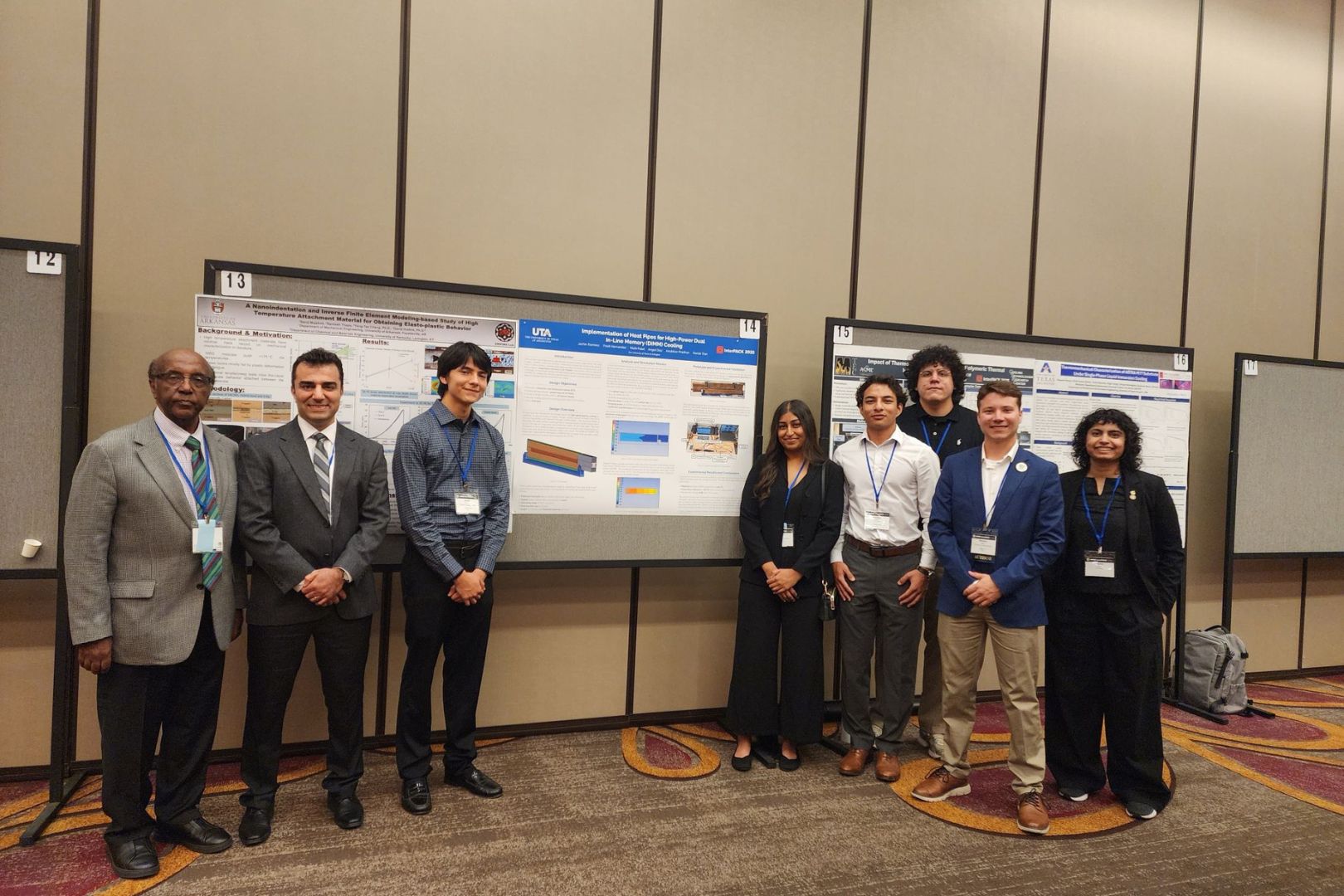
It began as one of several Senior Capstone projects at The University of Texas at Arlington. During the two-semester course, students complete a team-based engineering project, attend professional-practice lectures and receive guidance from faculty advisors.
It concluded with an award for the team of senior students who developed a passive cooling system designed for next-generation data centers.
Mechanical engineering seniors Jachin Ramirez, Freddy Hernandez, Nishi Patel, Anubhav Pradhan, Angel Diaz and Derick Tran won a Nasser Grayeli Best Poster Award at the American Society of Mechanical Engineers’ 2025 InterPACK Conference in Anaheim, California, an international gathering of researchers and industry experts in electronics packaging and heterogenous integration.
The team’s project received partial funding through a U.S. Department of Energy’s ARPA-E COOLERCHIPS grant led by Professor Dereje Agonafer—in collaboration with other universities—to advance the “Holistic Co-Design of Novel Hybrid Cooling Technology for the Data Center of the Future.”
From classroom concept to competitive prototype, this Senior Capstone project became much more than a grade for these six undergraduates. It was a chance to grow as they prepare for the next stage of their careers.
“What stood out to me was getting to experience the full engineering cycle,” Ramirez said. “We went from design and simulation to building to testing a working prototype. Seeing it all come together was incredibly rewarding.”
Related: Focus on a more sustainable world: Cooling data centers efficiently
The project—“Implementation of Heat Pipes for a Passive Cooling System for Dual In-line Memory Modules”—was completed under the guidance of Dr. Agonafer, presidential distinguished professor of mechanical engineering, with doctoral student mentor Braxton Smith.
At the ASME conference, the UTA team presented alongside graduate students and Ph.D. candidates from leading universities, as well as members of major industries.
“What really set us apart was how willing we were to talk about the project and how excited we were,” Pradhan said. “The judges noticed that.”
The event also gave students a clearer view of where their work fits into the fast-evolving landscape of data-center cooling.
“It was the first time I got to take something from design to testing and then see it in a real-world context,” Patel said. “Being able to present that to professionals in the field made the experience even more meaningful.”
A project tied to emerging industry needs
Through this capstone project, the undergraduate team contributed to Agonfer’s COOLERCHIPS project, a critical initiative aimed at reducing cooling energy consumption to less than 5% of a data center's information technology load.
Currently, cooling systems can account for up to 40% of a data center's total energy consumption. In addition to electricity, many data centers rely heavily on water for evaporative cooling—often using hundreds of thousands of gallons per day per facility.
To achieve the COOLERCHIPS energy-reduction goal, Agonafer’s team, alongside the University of Maryland–College Park, has developed a novel Direct-to-Chip Evaporative Coldplate (DCEC) that uses dielectric refrigerants as the cooling fluid.
Agonafer has also partnered with Austin-based Accelsius, a leader in two-phase, direct-to-chip liquid cooling, to advance this time-sensitive project. Accelsius provided its proprietary MR250 technology—a multi-rack, in-row, 250-kilowatt, two-phase Coolant Distribution Unit—for system-level testing and integration. The DCEC cools the high-power components in the server system, while innovative heatsink designs, like the one developed by the undergraduate team, supports the remaining components.
“In our COOLERCHIPS project, we’ve developed a very advanced 3D-printed metal heat sink using gyroid structures, allowing us to achieve twice the thermal performance compared to current market offerings,” Smith said. “Although our design can be manufactured cost effectively and at scale by our partner Fabric8Labs, we wanted to explore a more conventionally manufacturable design as well. This is where our fantastic undergraduate team came into play.”
For Smith, mentoring the seniors demonstrated how undergraduate work can meaningfully support large-scale industry partnerships.
“They were working with the same design constraints we did,” Smith said. “Their prototype showed far improved performance over current commercial offerings, opening a pathway to next-generation, higher-power memory modules.”
As students begin their next steps—some entering graduate school, others heading into industry—they say this project will continue to shape their careers.
Diaz said the experience strengthened his understanding of the future of thermal engineering.
“Things are changing fast,” he said. “Being able to work on a project that reflects where the industry is headed was exciting. It gave us a glimpse into the technologies that will define the next generation of data centers.”
About The University of Texas at Arlington (UTA)
Celebrating its 130th anniversary in 2025, The University of Texas at Arlington is a growing public research university in the heart of the thriving Dallas-Fort Worth metroplex. With a student body of over 42,700, UTA is the second-largest institution in the University of Texas System, offering more than 180 undergraduate and graduate degree programs. Recognized as a Carnegie R-1 university, UTA stands among the nation’s top 5% of institutions for research activity. UTA and its 280,000 alumni generate an annual economic impact of $28.8 billion for the state. The University has received the Innovation and Economic Prosperity designation from the Association of Public and Land Grant Universities and has earned recognition for its focus on student access and success, considered key drivers to economic growth and social progress for North Texas and beyond.