Monday, Mar 16, 2026
• Thomas Johns :
Thomas.Johns@uta.edu
The Native American Student Association (NASA) at the University of Texas at Arlington will host its 30th annual Powwow on April 4, bringing together dancers, singers, vendors and community members from across the country for a day of cultural celebration, competition and education.
For Stephen Silva-Brave, a doctoral student helping organize the event, the powwow is both deeply personal and widely misunderstood.
“Some of my cohort mates in the PhD program thought that a powwow was a big meeting,” Silva-Brave said. “What they mean is ‘let’s have a quick meeting about this topic.’ But a powwow is actually something very different, it’s a gathering, celebration and a way to continue Native American Culture.”
Silva-Brave described a powwow as “a big cultural celebration” centered on music, dance and regalia.
“The music is always going to be a drum,” he said. “The people who participate in it, they dance and they dress in regalia. They’re not wearing costumes. Participants wear regalia that tells a story, every stitch carries symbolism.”
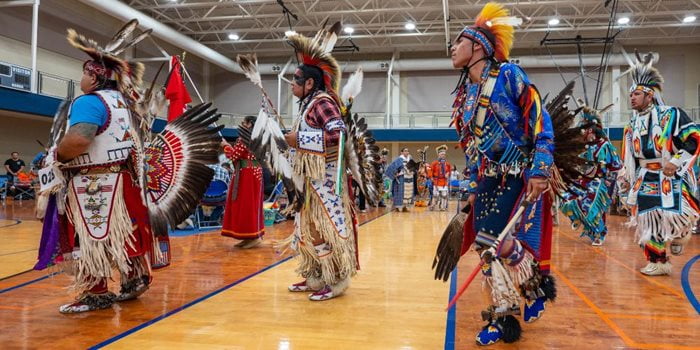
Participants dance at the 29th Annual Native American Student Association Powwow at the University of Texas at Arlington. (Photo by Cristal Gonzalez)
The distinction matters, he said, because each element carries meaning.
“If people are wearing a certain color, if they have a feather in a certain place, if they have a certain medallion on, the design that’s on their thing, everything means something,” Silva-Brave said. “These are really like works of art.”
While powwows may include spiritual elements, Silva-Brave emphasized that they are community events open to everyone.
“It’s not a ceremony. It’s not a spiritual event, it’s not a religious event, it’s a community gathering,” he said. “A lot of people think, ‘I’m not Native, so it’s not for me,’ but it is. That’s the whole reason why we’re having it here on campus is for people to come and learn about these things.”
The UTA Powwow blends education with competition. Dancers compete for prize money, with first place in each category earning $300, second place $200 and third place $100.
This year’s event will feature nine competition categories, along with special dances and a traditional Gourd Dance that opens the day.
Other categories include Fancy Dance, Women’s Fancy and Jingle, Grass Dance and Chicken Dance, among others. Judges evaluate dancers on regalia, precision and musicality.
“A big part of the competition hinges on contestants going with the beat,” Silva-Brave said. “When the beat stops, sometimes it’ll stop suddenly, did you stop suddenly? And when it picks up, do you speed up as it speeds up, slow down as it slows down?”
Though UTA’s powwow typically draws about 1,500 attendees and around 80 dancers, larger powwows across the country can span three days and draw thousands.
“We try to not be in conflict with some of the bigger powwows,” Silva-Brave said, noting that spring marks the start of powwow season largely because of the weather. “Winter is pretty much the only downtime where there’s not a lot of powwows nationally.”
Silva-Brave explained that modern intertribal powwows emerged in part from federal relocation programs in the 1950s and 1960s that encouraged Native Americans to move from reservations to urban centers such as Dallas, Denver and Chicago.
“The idea was to get native people to move off of reservations and to move into cities. And it was a way to assimilate,” he said. “This led to a lot of Native Americans feeling like they didn’t really fit in, but they various tribes in these places decided to keep their culture alive through intertribal powwows.”
What was intended as assimilation strengthened cultural connection.
“That came from them trying to make us less native,” he said. “And I think people decided to find ways to survive and thrive no matter what. We decided that we’re not going to stop being native.”
He added that Indigenous history is inseparable from American history.
“The indigenous history is United States history,” Silva-Brave said. “I mean, we’re the first peoples of this country.”
This year’s powwow will honor the legacy of Dr. Les Riding-In, a longtime advocate for Native students at UTA whose leadership helped grow the event.
“The whole event is focused on honoring him because of the major role he played in the lives of Native students at UTA,” Silva-Brave said.
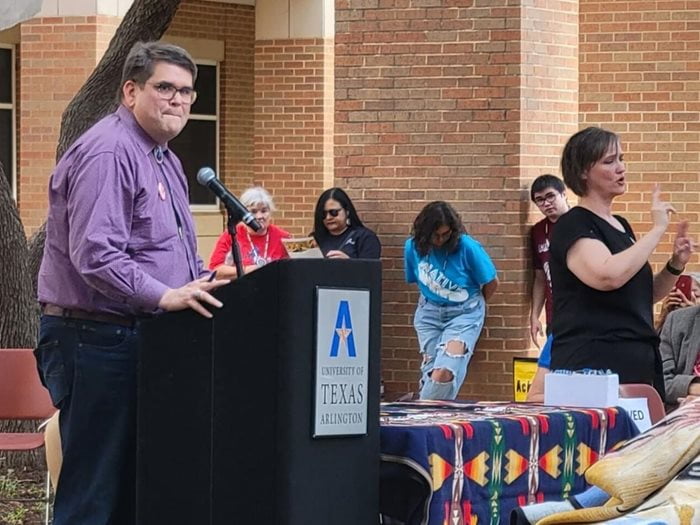
Dr. Les Riding-In speaks at an event at the University of Texas at Arlington (Photo by Stephen Silva-Brave)
Although the powwow existed before Riding-In arrived, the event expanded significantly under his leadership.
A special dance sponsored by Riding-In’s parents will award $500 for first place, more than the standard competition prize. The event will also include a prayer in Osage, reflecting Riding-In’s tribal heritage.
“Hopefully we’ll do him some justice,” Silva-Brave said. “Losing him has left huge hole. Even just us doing the powwow this year just feels way different without him.”
Ultimately, organizers hope the powwow serves as both celebration and education.
“If you’re in social work or in any area or profession where you care about community, this is a cool event to attend,” Silva-Brave said. “You can have a good time, but you also get to learn a lot about indigenous culture and history.”