UTA symposium highlights the human side of artificial intelligence
As artificial intelligence continues reshaping industries, business leaders say the organizations that succeed will be those that keep people at the center of the technology.
The UTA College of Business’ 10th Annual AI and Analytics symposium brought together industry executives, faculty and students to explore the theme of “Humans in the Age of AI.”
Keynote speaker Satheesh Heddese, vice president of frontline support at Amazon Web Services, described AI as part of a technological shift comparable to past disruptions such as the rise of the internet. Rather than simply optimizing existing systems, he said organizations should rethink processes entirely.
“What seemed like science fiction a few years ago, where your agent is talking to the customer’s agent without human oversight, is no longer hypothetical,” Heddese said.
But despite the rapid advancement of AI tools, Heddese emphasized that human judgment remains essential. While AI can analyze large datasets and identify patterns quickly, people still provide the nuance, creativity and ethical reasoning needed to guide decisions.
“We are moving away from AI as a tool to AI as a teammate,” Heddese said.
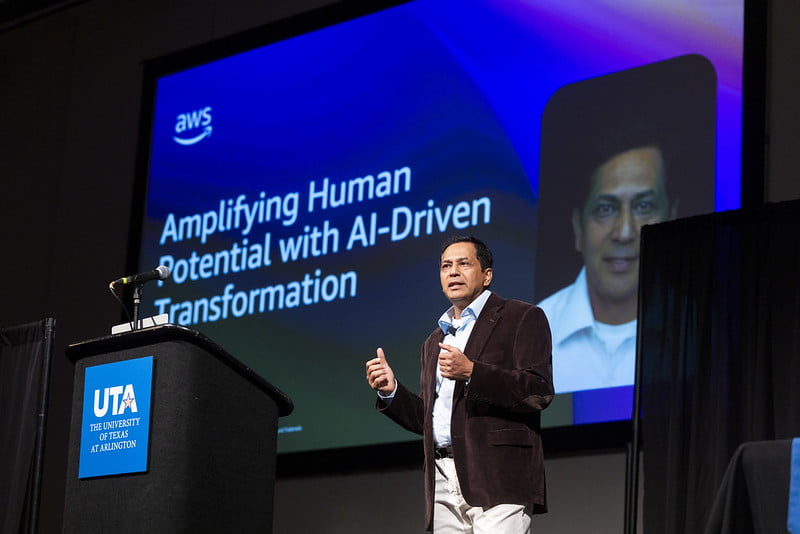
Satheesh Heddese speaks to attendees from a stage. Photo by Sharon Ellman.
Industry leaders from companies including AT&T, Bitwise and Sogeti, part of Capgemini, expanded on how organizations are integrating AI into their operations, from workforce analytics to digital transformation strategies.
A panel discussion moderated by Brian White, Ericsson Vice President of New Product Introduction and College of Business Dean’s Service Award winner, explored the broader implications of AI adoption across industries ranging from healthcare to cloud computing and legal services. Panelists stressed that AI should be viewed as a tool that enhances human productivity rather than replacing it entirely.
College of Business assistant professor of practice Dr. Adriana Sanford compared the shift to earlier technological transitions.
“Excel didn’t replace accountants,” she said. “It helped them do their jobs better.”
Other panelists emphasized the importance of responsible implementation, noting that organizations must balance innovation with oversight.
“AI without people is just a tool,” said panelist Carlos Orozco, senior manager ofengineering operations at AWS.
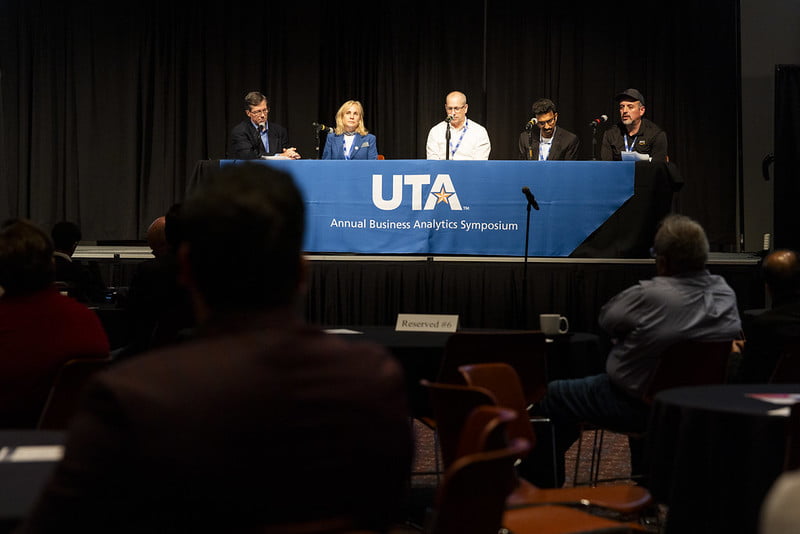
From left to right, Brian White, Adrianna Sanford, John Simon, Sharad Karkera and Carlos Orozco. Photo by Sharon Ellman.
The symposium also highlighted student innovation and curiosity through a competition sponsored by AWS. Three teams, two from UTA, presented AI driven concepts ranging from an AI-powered learning feed to helping small businessesremain ADA compliant.
Samuel Mamootil, a master’s student studying Information Systemswhose team worked on ReRhythm, an AI-based resume and application optimizer, said he chose to participate in the competition because it provided a bridge between classroom theory and real-world application.
“Through this competition, I was able to apply cutting-edge skills like AI, cloud computing, and Retrieval-Augmented Generation (RAG) to solve an actual business problem, which is exactly the kind of hands-on learning experience that sets UTA apart,” Mamootil said.
Mamootil said that through the competition, and by attending the conference itself, he wasable tonetwork with industry professionals and recruiters from top companies in the analytics industry, as well as the opportunity to connect with like-minded peers.
“I walked away with new friendships and a stronger sense of community, having collaborated with talented peers who pushed me to grow both professionally and personally,” Mamootil said.
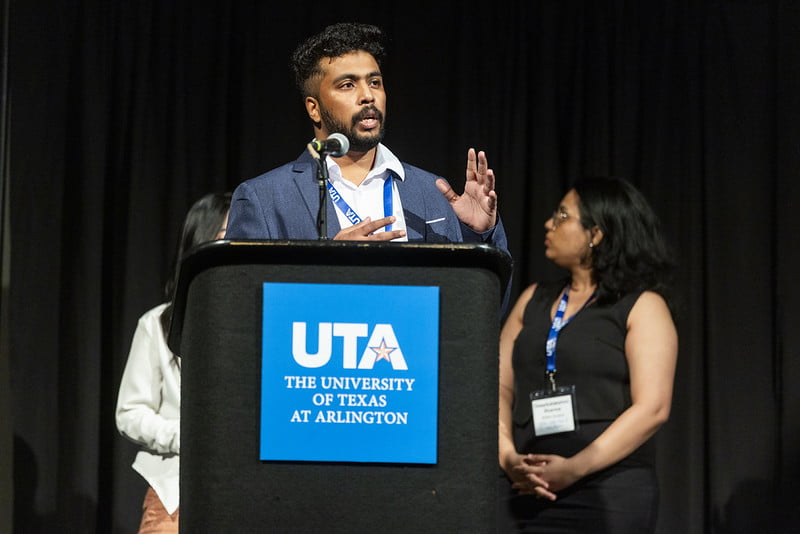
Samuel Mamootil speaks to attendees from a podium. Photo by Sharon Ellman.
In addition to presentations and panel discussions, attendees participated in poster sessions, networking events and roundtable discussions led by industry experts and faculty members.
As AI continues to transform the workplace, speakers repeatedly returned to a central theme: technology may change how work is done, but human involvementwill remain essential.
For students preparing to enter the workforce, Heddese offered simple advice.
“Contextual judgment, empathy and curiosity,” he said. “Those are the skills you need to develop as you work alongside AI.”